Revolutionizing Software Dev with Amazon Q & CodeNOW | AWS Prague 2024
Insights from AWS Prague 2024 on revolutionizing software development with Amazon Q and CodeNOW.
Overview
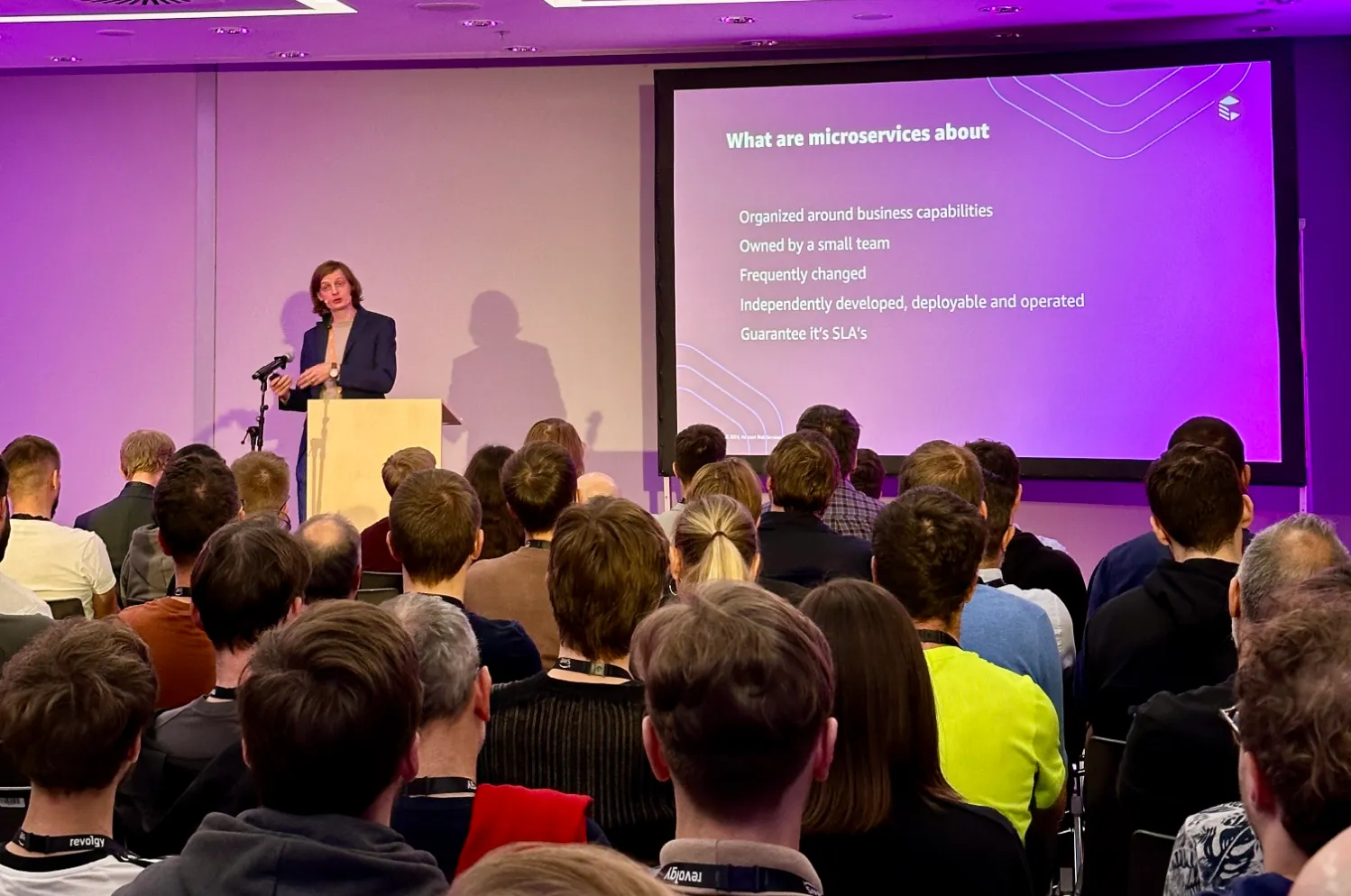
At AWS Day Prague, CodeNOW's CEO Petr Svoboda demonstrated rapid microservices development. In just 20 minutes, he constructed two microservices using Amazon Q and the CodeNOW platform, showcasing how modern tools can dramatically accelerate cloud-native application delivery.
The Microservices Adoption Challenge
Many enterprises hesitate to adopt microservices architecture, perceiving it as overly complex or resource-intensive. However, the real obstacles emerge during implementation:
- Testing and deployment complexity
- Transitioning between on-premises and cloud environments
- Increased automation and monitoring demands
Unlike monolithic systems, "microservices require these tasks to be repeated for every service" without automation, creating significant operational overhead that diverts developer focus from business-critical features.
Building Two Microservices in 20 Minutes
The Three-Tier Application Structure
Svoboda's demonstration showcased an omnichannel application architecture comprising:
- Front-end layer
- Back-end for front-end (BFF) layer
- Core back-end component
This structure handles diverse client requirements while maintaining unified business logic across all channels.
Development Environment Strategy
Personal Cloud Development Spaces
The platform employs a "share-nothing" approach, providing developers with isolated, cloud-based environments. This enables:
- Independent schema management
- Isolated feature testing
- Productivity regardless of physical location
Component Stack
Development environments typically include:
- Back-end-for-front-end exposing REST APIs
- Kafka for messaging and event streaming
- PostgreSQL for data persistence
Managed Services for Production
Higher environments (staging/production) transition to managed cloud services:
- AWS RDS for PostgreSQL
- Managed Kafka instances
These services provide built-in scalability, monitoring, and disaster recovery capabilities.
Streamlined Workflow: From Coding to Deployment
Five-Stage Pipeline
The standard delivery process follows these steps:
- Coding
- Versioning
- Release management
- Deployment
- Testing
Infrastructure as Code Implementation
Svoboda demonstrated creating new development environments using Kubernetes namespaces. Application components were initialized from golden templates and scaffolded to Git repositories with project-specific configurations.
Following "12-factor app principles," external service connections were dynamically configured during deployment, ensuring seamless transitions across environments.
Leveraging AI for Code Generation
Amazon Q Integration
Despite limited Python expertise, Svoboda used Amazon Q to generate frontend code, including:
- Form rendering functionality
- External BFF connections
- Backend HTTP response handling (200 for success, 400 for validation errors)
CI/CD and GitOps Workflow
Git-Centric Development
The entire workflow centered on Git repositories, where code changes automatically triggered CI pipelines. Integration with GitHub Actions ensured:
- Seamless component management
- Consistent pipeline orchestration
- Enforced permission controls
Release Automation
The process involved:
- Creating releases by satisfying dependencies
- Synchronizing state to target environments using Argo CD
- Automating deployments via Infrastructure as Code tools (Terraform)
Performance Validation
Load Testing and Observability
Amazon Q generated K6 load testing scripts targeting the BFF endpoint. Results were monitored through:
- Grafana dashboards for metrics visualization
- Log aggregation and live tails
- End-to-end code tracing for troubleshooting
Key Takeaways
Svoboda emphasized critical architectural principles:
- Domain-Driven Design (DDD): Ensures appropriate software component sizing and logical separation
- Self-service platforms: Minimize unnecessary development-operations communication
- Immutable infrastructure: Strengthens reliability and simplifies disaster recovery
- Integrated platforms: "Unify the developer experience across the entire software development lifecycle"
Resources
- Video Demo: Available on YouTube
- Book a Demo: Schedule a live demonstration
Written by CodeNOW